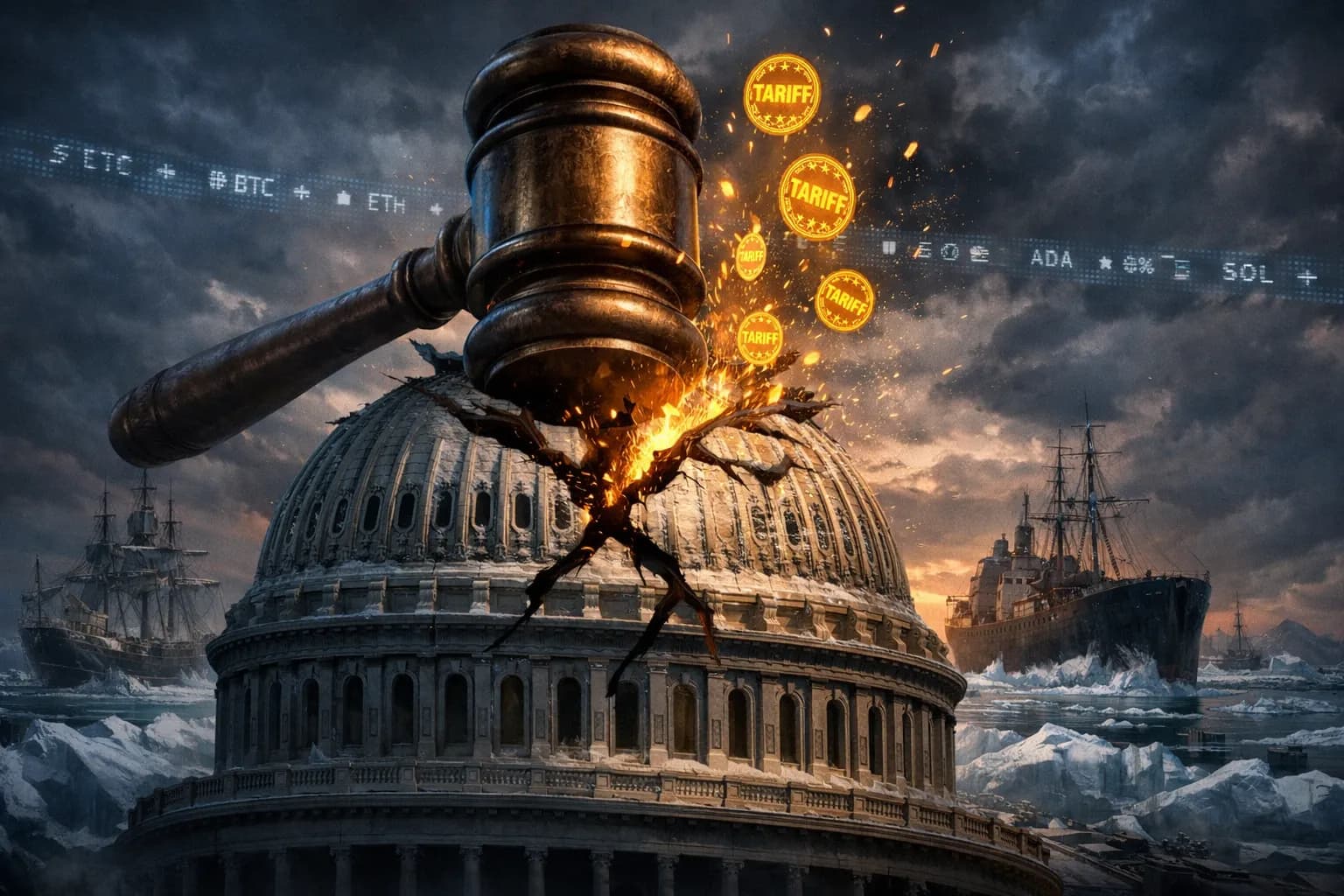
Hours after the Supreme Court delivered a 6-3 ruling that killed his sweeping IEEPA tariffs, President Trump fired back with a new weapon: Section 122 of the Trade Act of 1974. The executive order, signed on February 20, 2026, imposes an additional 10 percent tariff on imports from every country on Earth. It is the first time any president has invoked Section 122 for tariff purposes, and the clock is already ticking on a 150-day countdown that expires in mid-July unless Congress votes to extend it.
Bitcoin, as of the signing, was trading near $68,000, up roughly 2 percent on the day before retracing to the $67,000 level. The broader CoinDesk 20 index gained 2.5 percent over 24 hours, with Solana, Dogecoin, Cardano, and BNB posting 3 to 4 percent advances. For an executive action that reshapes global trade policy, the crypto market's reaction was conspicuously muted.
A Law Designed for Currency Crises, Repurposed for Trade War
Section 122 was written in 1974 during the aftermath of the Nixon-era balance-of-payments crisis. Congress designed it as a narrow emergency tool: the president could impose tariffs of up to 15 percent to defend the dollar's value in foreign exchange markets and correct trade imbalances. The key constraint is a hard 150-day sunset. Without an act of Congress, the tariffs automatically expire.
No president has ever used it. The statute sat dormant for over half a century while trade disputes were typically handled through Section 232 (national security) and Section 301 (unfair trade practices). Trump's decision to dust off Section 122 came within hours of the Supreme Court's ruling that his use of the International Emergency Economic Powers Act to impose tariffs was unconstitutional.
The IEEPA tariffs, which had generated more than $160 billion in revenue since their implementation, were projected to bring in $1.4 trillion over the next decade according to the Tax Foundation. That revenue stream is now gone. Section 122, capped at 15 percent and limited to 150 days, is a fraction of the firepower Trump had before.
What Survives the Supreme Court Ruling
The court's decision did not wipe the trade-policy slate clean. Two major tariff authorities remain untouched:
Section 232 tariffs cover steel, aluminum, copper, automobiles and auto parts, and lumber. These duties are justified under national security grounds and were not challenged in the IEEPA case. According to TD Economics, Section 232 tariffs are projected to generate roughly $635 billion over the next decade and cost the average American household approximately $400 per year in 2026.
Section 301 tariffs currently apply only to China, targeting what the US Trade Representative has identified as anticompetitive practices in technology and intellectual property. The Trump administration has also launched several new Section 301 investigations that could lead to additional duties on specific countries or sectors.
Combined with the new 10 percent Section 122 surcharge, the effective tariff landscape is now a patchwork: universal 10 percent on everything, plus sector-specific duties on metals, autos, and Chinese goods. The Tax Foundation estimates that the Supreme Court ruling eliminates nearly three-quarters of the administration's planned tariff revenue, shrinking a projected 0.3 percent GDP drag from the IEEPA duties alone.
Why Crypto Shrugged
The muted market reaction reveals how much the tariff narrative has already been priced into crypto. The day unfolded in three acts:
- The Supreme Court ruling initially sent Bitcoin up 2 percent past $68,000 as traders bet that removing IEEPA tariffs would ease inflation pressure and strengthen the case for eventual rate cuts.
- Trump's Section 122 announcement clawed back most of those gains, pushing BTC back toward $67,000 as the market realized tariffs were not going away entirely.
- The net result was a wash. Risk assets, including crypto, ended the session modestly higher because the new tariffs are structurally weaker than what they replaced.
The 150-day sunset is the key detail. Markets are forward-looking, and a tariff that automatically expires in mid-July is fundamentally different from an open-ended IEEPA regime. If Congress does not extend it, and there is no indication yet that the votes exist to do so, the Section 122 duties vanish on their own.
For crypto holders managing stablecoin positions or dollar-denominated portfolios, the calculus is relatively straightforward: the macro backdrop just got marginally better. The IEEPA tariffs were a persistent inflation accelerator. Their removal, even with a partial Section 122 replacement, reduces the tail risk of a stagflationary spiral that had been weighing on risk assets since Q4 GDP came in at just 1.4 percent.
The 150-Day Clock and What Comes Next
The most important number in this story is not 10 percent. It is 150.
Section 122 tariffs expire automatically around mid-July 2026. Between now and then, three scenarios are in play:
Scenario 1: Congress extends. This requires a floor vote in both chambers. Given the current political dynamics, where even many Republicans opposed the IEEPA tariffs, extension is far from guaranteed. If Congress does act, the tariffs become semi-permanent but also subject to ongoing legislative negotiation.
Scenario 2: The tariffs expire quietly. Trump uses the 150-day window as leverage in trade negotiations, secures concessions from key partners, and lets Section 122 sunset. This is the market's base case, which explains the muted reaction.
Scenario 3: Legal challenge. Section 122 has never been tested in court. Legal scholars at the Cato Institute have already flagged that using a balance-of-payments statute to address trade deficits may stretch the law beyond its intended scope. A challenge could reach the courts within weeks, potentially freezing the tariffs before the 150-day clock runs out.
For crypto traders, Scenario 2 is the bull case: a cleaner macro environment by summer, reduced inflation pressure, and stronger odds of a Fed pivot. Scenario 3 would accelerate that timeline. Only Scenario 1, a congressional extension, would meaningfully change the calculus, and even then, 10 percent is far less punitive than the IEEPA regime that peaked at much higher effective rates.
What Crypto Card Holders Should Watch
For anyone spending crypto through a card, the tariff shifts matter at the margins. Import tariffs flow through to consumer prices within 60 to 90 days. The IEEPA removal should put downward pressure on goods inflation in the US by late Q2, which benefits purchasing power for cardholders spending in the US.
Meanwhile, the S&P 500 rose 0.5 percent and Treasury yields ticked up 2 to 3 basis points on the day. The bond market's modest reaction suggests that investors view the net tariff reduction as marginally disinflationary, which supports the case for rate stability rather than further tightening. A stable or declining rate environment historically correlates with stronger crypto performance and higher cashback yields on DeFi-linked card programs.
The dollar's trajectory is the wildcard. Section 122 was literally designed to prevent dollar depreciation. If the tariffs succeed in narrowing the trade deficit, the dollar could strengthen, creating headwinds for Bitcoin's price in dollar terms but improving purchasing power for US-based crypto spenders abroad using zero FX fee cards.
Overview
The Supreme Court's 6-3 IEEPA ruling on February 20 eliminated nearly three-quarters of the Trump administration's tariff revenue. Trump's immediate response, a 10 percent global surcharge under the never-before-used Section 122, is structurally weaker: capped at 15 percent, limited to 150 days, and already facing legal questions. Crypto markets treated the net outcome as marginally positive, with Bitcoin holding near $68,000 and altcoins posting modest gains. The 150-day countdown to mid-July is now the key macro variable for risk assets, with congressional action, trade negotiations, and potential legal challenges all capable of altering the trajectory before the tariffs sunset automatically.
Recommended Reading
- The Supreme Court Just Killed Trump's Emergency Tariffs in a 6-3 Ruling, and $175 Billion in Refunds Could Reshape the Macro Landscape for Crypto
- Goldman Sachs Says the Supreme Court Tariff Ruling Will Not End Trade Barriers as Trump Confirms a Backup Plan That Could Hit Crypto Markets Within Days
- US Q4 GDP Comes in at 1.4 Percent, Missing 3.0 Percent Expectations by Half as a Government Shutdown and Rising Inflation Create a Stagflationary Trap