Black Tuesday in Seoul: The Largest KOSPI Wipeout Since the Yen Carry Trade Crisis
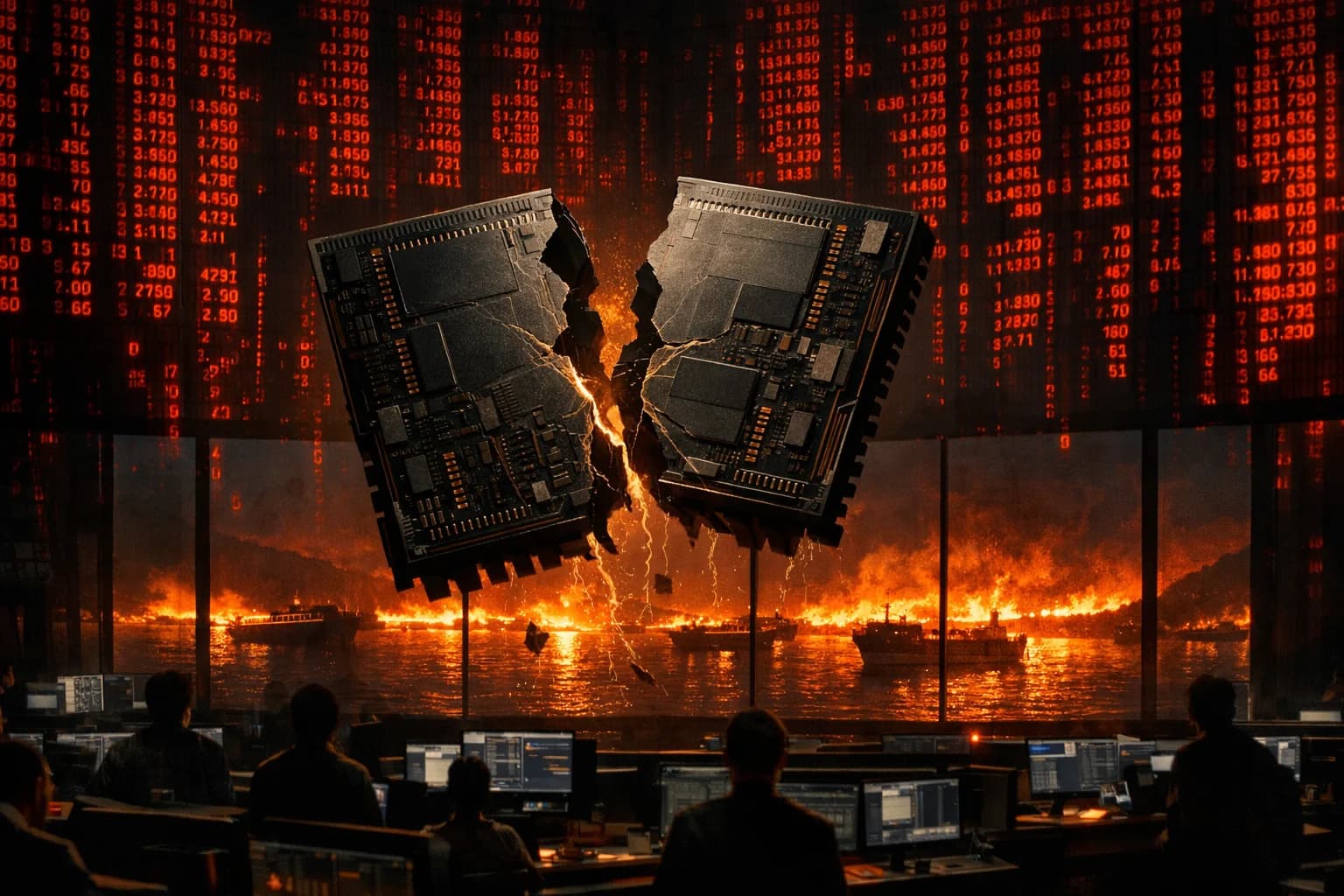
South Korea's benchmark KOSPI index plunged 7.24% on March 3, 2026, closing at 5,791.91 and triggering sell-side circuit breakers for the first time since the August 2024 yen carry trade crisis. The single-session drop erased roughly 390 trillion won, approximately $270 billion, in market value.
As of March 4, as of the time of writing, the bleeding has not stopped. The KOSPI fell another 3.66% in early trading, with intraday lows touching 6% declines. The KOSDAQ, South Korea's tech-heavy secondary index, also dropped as much as 6% during Tuesday morning trading. Foreign investors and retail traders dumped a combined 403.2 billion won of equities by 10 a.m. local time.
Market authorities activated the sell-side circuit breaker when the KOSPI 200 futures index fell more than 5%, temporarily halting all program selling to prevent cascading liquidations. It was only the second time in two years that Korean regulators were forced to pull the emergency brake.
Why the Strait of Hormuz Broke Seoul's Markets
The trigger was not domestic. Over the weekend, "Operation Epic Fury," a joint U.S.-Israeli military strike on Iranian nuclear and leadership infrastructure, escalated into what multiple governments now describe as a full-scale regional crisis. Iran responded by threatening to block the Strait of Hormuz, the maritime chokepoint that handles roughly 20% of the world's daily oil supply.
Brent crude surged more than 13% in a single session, pushing past $85 per barrel. For South Korea, which imports nearly 100% of its crude oil, the price shock was existential. The country's economy runs on cheap energy: Samsung's fabrication plants, SK Hynix's DRAM facilities, Hyundai's assembly lines, and LG's battery production all depend on stable energy costs. A sustained oil price spike above $85 threatens margins across every major Korean exporter.
The timing compounded the damage. Korean markets were closed for a long holiday weekend, meaning three days of panic had nowhere to go until Monday's opening bell. The gap-down was immediate and violent.
Samsung and the Semiconductor Rout
Samsung Electronics, South Korea's largest company by market capitalization, crashed 9.88% on March 3 and opened another 5.59% lower on March 4, extending losses to 7.94% intraday. The stock fell from the "200,000 won Samsung" level that analysts had defended for months to 179,600 won in pre-market trading on the second day.
The semiconductor angle has its own catalyst beyond Iran. Reports surfaced that mass production at Samsung's U.S. fabrication plant in Taylor, Texas had been pushed back to 2027 from 2026. For a company already losing ground to TSMC in the advanced node race, the delay compounded the geopolitical sell-off.
SK Hynix, the world's second-largest memory chipmaker, dropped 11.50% on March 3 and continued falling on March 4 to 842,000 won. The "1 million won Hynix" narrative that dominated Korean retail investing forums for months evaporated in two sessions.
Other major names were not spared. Hyundai Motor and Kia each fell roughly 11% on March 3 and another 5% on March 4. LG Energy Solution dropped 7.96% then 3%. SK Square lost 9.92% then 6%. HD Hyundai Heavy Industries, despite being an energy-adjacent name, fell 7% on the second day.
Defense Stocks: A 20% Swing in One Hour
The only winners on March 3 were defense stocks. Hanwha Aerospace surged 19.83% and Korea Aerospace Industries gained 3.19% as investors bet on increased military spending.
But even that trade reversed violently. On March 4, Hanwha Aerospace opened 10% higher in pre-market, then swung to a 7% loss after the regular session began. That is a nearly 20 percentage point reversal in just over an hour, the kind of intraday volatility that usually signals forced liquidations or margin calls rather than rational repricing.
What This Means for Crypto Holders in South Korea
South Korea's crypto market operates under unique conditions. The "Kimchi premium," where Korean exchanges historically price Bitcoin 2-5% above global markets, tends to spike during domestic financial stress as retail investors seek alternative stores of value. During the August 2024 yen carry trade crisis, Korean crypto volumes surged even as equities collapsed.
As of the time of writing, Bitcoin is trading near $66,348 with the Fear and Greed Index sitting at 10, deep in "extreme fear" territory. The broader crypto market has already absorbed significant damage from the Iran strikes earlier in the week, with liquidations exceeding $200 million in a single day.
For Korean crypto holders specifically, the KOSPI collapse adds a second layer of portfolio stress. Many retail investors in South Korea hold both equities and crypto. A 7% drop in equities can trigger margin calls that force crypto liquidations, even if crypto fundamentals have not changed. This cross-asset contagion is a repeating pattern in Korean markets.
South Korea's crypto regulatory framework, formalized under the Virtual Asset User Protection Act that took effect in 2024, requires exchanges to maintain strict reserve ratios. This means Korean exchanges like Upbit and Bithumb are structurally more resilient than they were during previous crises, but it does not prevent retail panic selling.
Users holding self-custody cards or stablecoin-denominated spending tools may find themselves better positioned during equity-driven selloffs. When local currency and equity markets are both falling, the ability to hold and spend USDC or USDT without touching a Korean exchange provides a layer of insulation that exchange-custodied assets cannot offer.
The Oil Price Wildcard and Global Contagion
The KOSPI crash is not happening in isolation. Japan's Nikkei also suffered sharp losses, and broader Asian markets are under pressure. The critical variable is whether Iran follows through on the Strait of Hormuz threat. If the strait is partially or fully disrupted, oil could spike well above $100 per barrel, turning a two-day Korean correction into a sustained global bear market for energy-dependent economies.
For the crypto ecosystem, sustained oil price shocks historically produce mixed signals. Higher energy costs raise the floor for Bitcoin mining profitability, potentially reducing sell pressure from miners who can no longer operate at a profit. But they also tighten consumer spending globally, reducing retail flows into risk assets including crypto.
Tokenized gold has already demonstrated its utility as a weekend price discovery mechanism, and the current environment is exactly the kind of crisis that drives demand for on-chain safe haven assets. Gold itself smashed past $5,360 during this week's trading.
FAQ
Has the KOSPI circuit breaker been triggered before? Yes. The most recent activation before this week was during the August 2024 yen carry trade crisis, when a sudden unwinding of leveraged yen positions sent global markets into a tailspin. Before that, circuit breakers activated during the March 2020 COVID crash.
How does a circuit breaker work in South Korea? The Korea Exchange activates sell-side circuit breakers when the KOSPI 200 futures index falls more than 5%. This temporarily halts all program selling (automated trades) to prevent cascading sell orders from amplifying the decline. The halt lasts 5 minutes, after which trading resumes.
Did the KOSPI crash affect Bitcoin prices? Bitcoin was already under pressure from the Iran military escalation earlier in the week. The KOSPI crash adds indirect pressure through cross-asset margin calls, where Korean investors liquidate crypto holdings to cover equity losses. Bitcoin is trading near $66,348 with the Fear and Greed Index at 10.
How much has the KOSPI lost in total this week? South Korea's stock market lost approximately $230-270 billion in a single week. The March 3 session alone erased roughly 390 trillion won ($270 billion). Second-day losses on March 4 are still accumulating.
Overview
South Korea's KOSPI index triggered sell-side circuit breakers after plunging 7.24% on March 3, 2026, erasing $270 billion in market value in the largest single-session wipeout since the 2024 yen carry trade crisis. The crash was driven by Iran war escalation fears following Operation Epic Fury, a Strait of Hormuz blockade threat that sent Brent crude above $85, and a Samsung semiconductor production delay. Samsung fell nearly 10%, SK Hynix dropped 11.5%, and Hyundai lost 11.7%. On March 4, selling continued with the KOSPI down another 3.66% in early trading. The crypto market faces indirect pressure through cross-asset margin calls as Korean retail investors hold both equities and digital assets. Bitcoin trades near $66,348 with the Fear and Greed Index at 10.
Recommended Reading
- Israel Launches a Preventive Strike on Iran and $100 Million in Crypto Longs Evaporate in 15 Minutes
- Over $9 Billion Flees Bitcoin and Ether ETFs in Four Months, the Longest Monthly Losing Streak Since Launch
- Tokenized Gold Now Handles All Weekend Price Discovery While CME Futures Sit Dark