Justin Sun Settles Fraud Charges, Then Backs the President's Token
On March 5, 2026, Justin Sun reached a $10 million settlement with the Securities and Exchange Commission to resolve civil fraud allegations. The SEC had accused Sun of generating $31 million through wash-trading and undisclosed celebrity promotions tied to his TRON ecosystem. The settlement required no admission of wrongdoing.
Five days later, Sun's cumulative investment in World Liberty Financial, the crypto venture linked to the Trump family, stands at a minimum of $75 million. He joined the project as an adviser and one of its largest token holders. The timing, as of March 8, 2026, has drawn scrutiny from lawmakers and ethics groups, though no formal investigation has been announced.
The Sun settlement is not an isolated event. It sits inside a broader pattern of the SEC unwinding its most aggressive crypto enforcement actions, one that accelerated sharply through 2025 and into 2026.
The SEC's Enforcement Retreat by the Numbers
The regulatory thaw extends well beyond Justin Sun. Three of the SEC's highest-profile crypto enforcement actions have now been resolved in ways favorable to the defendants:
Binance dismissal (May 2025): The SEC dismissed its civil lawsuit against Binance "with prejudice," meaning it cannot be refiled. The original complaint, filed in June 2023, accused Binance of operating an unregistered exchange, misleading investors, and commingling customer funds. The dismissal eliminated what had been the SEC's most consequential active case against a crypto exchange.
Changpeng Zhao pardon (October 2025): President Trump pardoned Binance founder Changpeng Zhao, who had pleaded guilty in November 2023 to anti-money-laundering violations. Zhao served four months in prison and Binance paid $4.3 billion in fines. The pardon restored his civil rights and removed the felony from his record.
Justin Sun settlement (March 2026): The $10 million payout resolved allegations that could have carried far steeper penalties given the $31 million in alleged wash-trading profits. No admission of wrongdoing, no ongoing monitoring, no industry ban.
Each resolution followed the same template: a relatively light financial outcome, no structural changes to the defendant's business, and no restrictions on future crypto activity.
World Liberty Financial's Revenue Machine
The project absorbing Sun's capital is not a typical DeFi protocol. World Liberty Financial operates with a revenue structure that directly enriches the Trump family.
Seventy-five percent of WLFI token sale revenue flows to a Trump family entity after operating expenses are deducted. The remaining 25% funds development and operations. This structure was disclosed in the project's founding documents and has not changed.
The project's stablecoin, USD1, launched in March 2025 and has grown into a $4.4 billion asset, making it the sixth-largest stablecoin by market capitalization as of March 2026. The broader stablecoin market sits at $313 billion with 3.7% monthly growth.
USD1 generates revenue through reserve yields on the assets backing each token, an approach shared by Tether's USDT and Circle's USDC. At a $4.4 billion market cap and current Treasury yields, the annual reserve income likely exceeds $200 million, though the project has not disclosed exact figures.
The Trump Organization reported $802 million in crypto-related revenue during the first half of 2025, a figure that includes WLFI token sales, licensing fees, and related ventures.
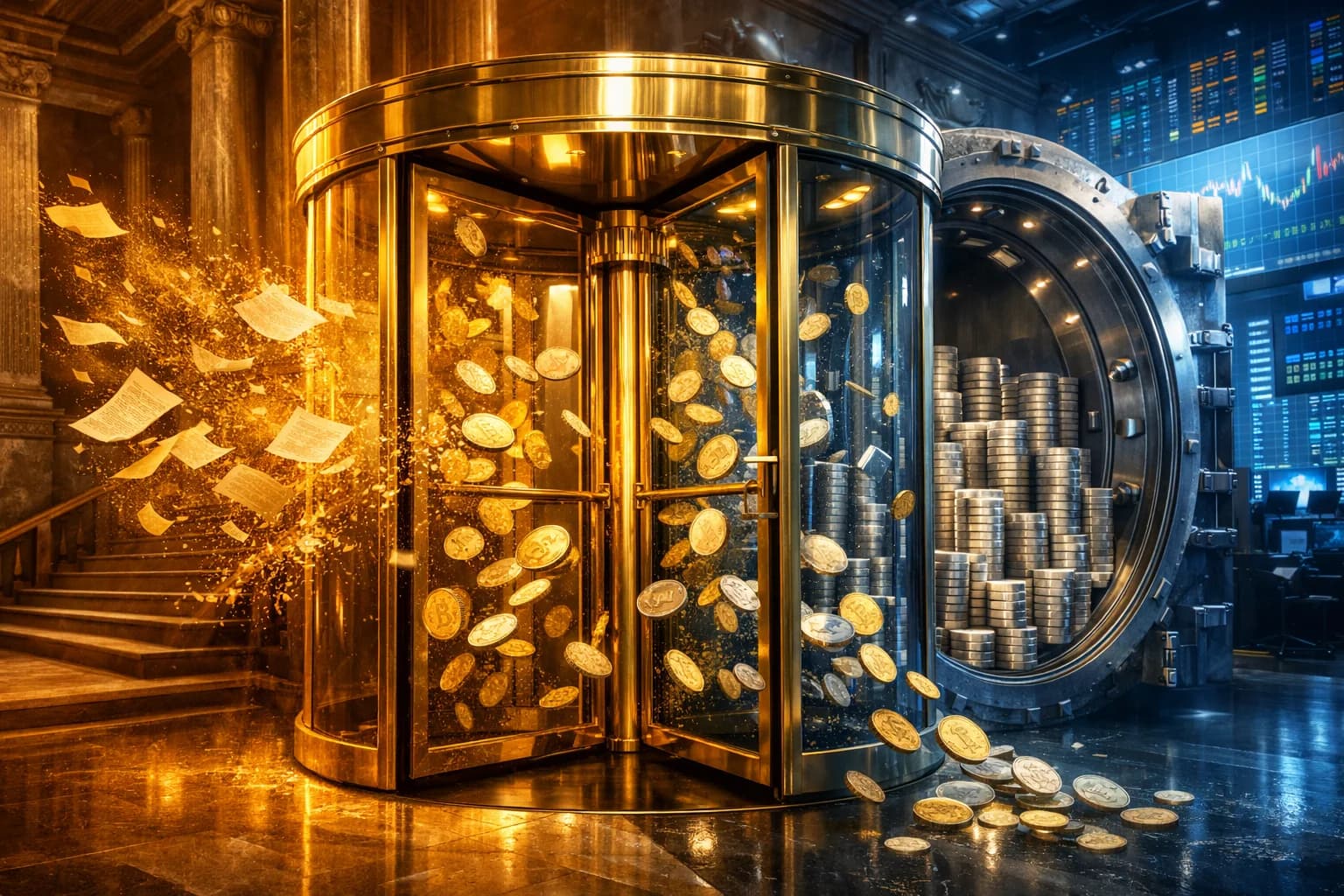
The Revolving Door Problem
The sequence matters. A regulatory body drops or settles its cases against major crypto figures. Those same figures then invest tens of millions into a project that sends most of its revenue to the sitting president's family.
No one has alleged a direct quid pro quo. But the pattern creates what ethics scholars call an "appearance problem," a situation where the mechanics of influence are visible even if the intent is not.
The Senate Banking Committee flagged the pattern in a February 2026 letter requesting documents from both the SEC and World Liberty Financial. The letter noted that "the proximity of enforcement resolutions and subsequent investments in presidential ventures warrants transparency about any communications between the parties."
Sun is not the only major crypto figure with investments in World Liberty Financial, but his $75 million commitment is among the largest disclosed positions. His advisory role gives him access to the project's governance and direction.
For crypto card users and everyday holders, the regulatory environment directly affects which products remain available. The SEC's retreat from enforcement has coincided with an expansion of crypto card offerings from exchanges that were previously under regulatory pressure. Binance, for instance, has expanded its card program into new markets since the dismissal.
What the Precedent Means for Enforcement
The SEC under its current leadership has not announced any new major enforcement actions against crypto firms since mid-2025. The agency's crypto enforcement unit, renamed from the "Crypto Assets and Cyber Unit" to the "Emerging Technologies Unit" in early 2025, has shifted its focus toward fraud cases targeting retail investors rather than structural actions against major exchanges or protocols.
This represents a philosophical reversal. Under former Chair Gary Gensler, the SEC filed 46 crypto-related enforcement actions in 2023 alone. The pace dropped to 18 in 2024 and just 6 in the first half of 2025 before the current near-halt.
For the industry, this creates a dual reality. Builders and exchanges operate with less regulatory uncertainty, which has accelerated product launches, new card partnerships, and institutional entry. But the absence of enforcement also means that the consumer protections those cases were meant to establish remain undefined.
The stablecoin legislation moving through Congress could partially fill this gap. Florida's SB-314, passed 37-0 in the state Senate, and the federal GENIUS Act both attempt to create regulatory frameworks for stablecoins without relying on enforcement actions. But neither addresses the broader question of exchange regulation or the conflicts of interest that arise when enforcement targets become political investors.
What Happens Next
Three developments to watch in the coming weeks:
Senate Banking Committee response. The committee's February letter gave the SEC and World Liberty Financial 30 days to produce documents. That deadline falls in mid-March. Compliance, partial compliance, or defiance will signal how seriously the administration treats congressional oversight of crypto-political entanglements.
Sun's TRON activity. With the SEC settlement behind him, Sun faces no US regulatory constraints on TRON development or token issuance. Any new token launches or ecosystem expansions will test whether the settlement truly closes the chapter or merely pauses it.
USD1 growth trajectory. At $4.4 billion and growing, USD1 is approaching the market cap of DAI ($5.1 billion) and could surpass it within months. A presidential stablecoin in the top five would create unprecedented questions about monetary policy conflicts.
FAQ
Did Justin Sun admit to wrongdoing in the SEC settlement? No. The $10 million settlement explicitly required no admission of wrongdoing. Sun paid the fine and the case was closed.
How much has Justin Sun invested in World Liberty Financial? At least $75 million in WLFI token purchases, making him one of the project's largest known investors. He also serves as an adviser.
Where does World Liberty Financial's revenue go? Seventy-five percent of token sale revenue flows to a Trump family entity after operating expenses. The remaining 25% funds development and operations.
Is USD1 the same as USDC or USDT? USD1 is a separate stablecoin launched by World Liberty Financial in March 2025. It operates on a similar reserve-backed model but is controlled by the Trump-linked venture rather than Circle or Tether. Its market cap is $4.4 billion as of March 2026.
How does the SEC enforcement retreat affect crypto card users? The reduced regulatory pressure has allowed exchanges like Binance to expand card programs into new markets. However, the lack of enforcement also means fewer consumer protection precedents exist if something goes wrong with a card issuer.
Overview
The SEC settled its fraud case against Justin Sun for $10 million with no admission of wrongdoing, completing a pattern that includes the Binance dismissal and CZ pardon. Sun's $75 million investment in World Liberty Financial, which sends 75% of token revenue to the Trump family, has drawn Senate scrutiny. USD1, the project's stablecoin, has reached $4.4 billion in market cap. The enforcement retreat has created favorable conditions for crypto product expansion but leaves consumer protection frameworks undefined.
Recommended Reading
- USDC Flips Tether in Transfer Volume as Stablecoin Transactions Hit a Record 1.8 Trillion Dollars
- A Federal Judge Dismisses the Terror Financing Lawsuit Against Binance and CZ as 535 Victims Prepare to Refile
- Florida Passes the First State-Level Stablecoin Bill 37-0, and the Governor Has 30 Days to Make It Law