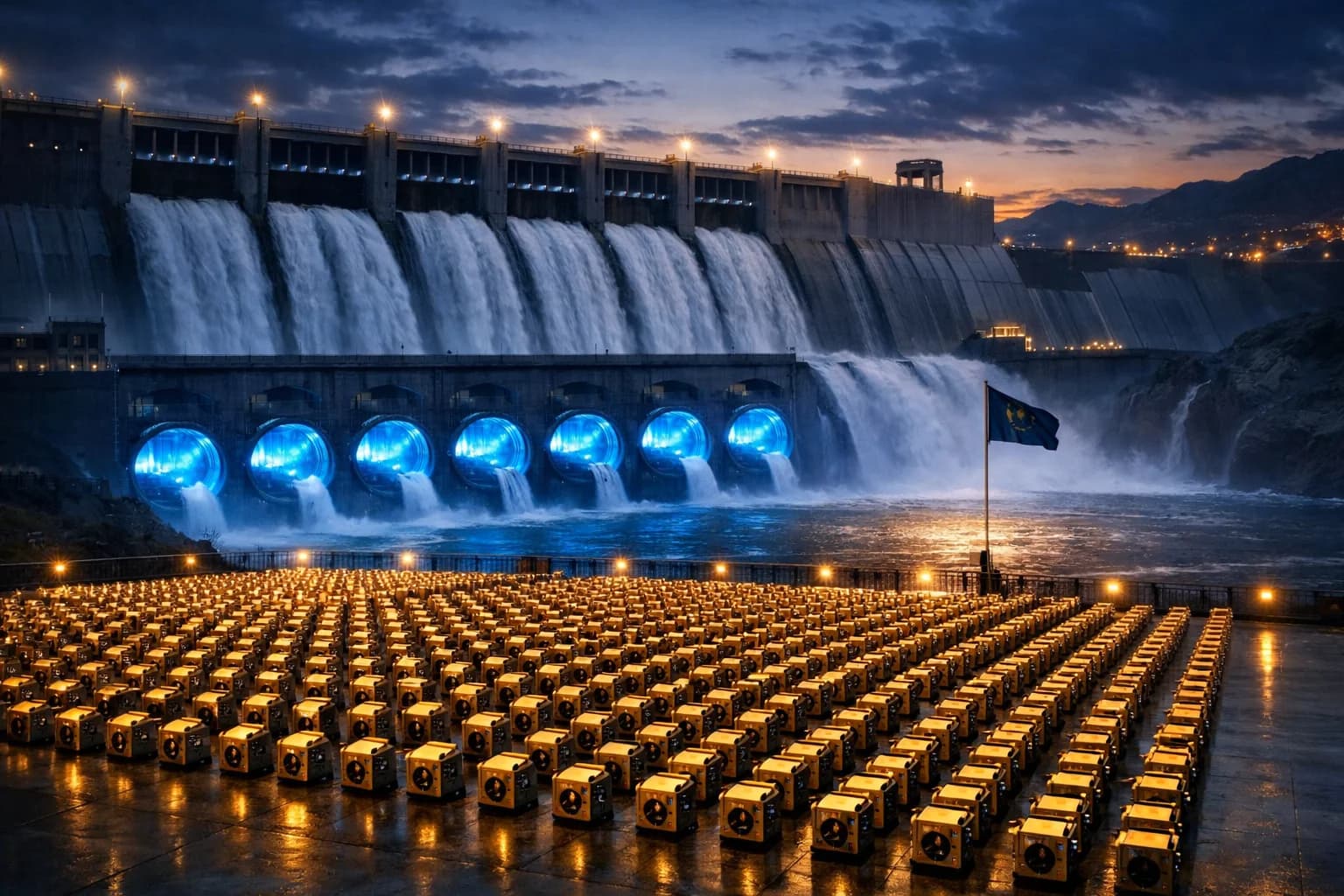
Paraguay's state electricity monopoly just signed a Memorandum of Understanding with cryptocurrency infrastructure company Morphware to launch the country's first government-led Bitcoin mining operation, and the raw materials are already sitting in government warehouses: roughly 30,000 mining machines seized from illegal operators over the past two years. The pilot phase will redeploy 1,500 of those confiscated rigs at utility-controlled sites near hydroelectric substations, as of March 4, 2026, according to Bitcoin Magazine and a post from Wu Blockchain.
30,000 Miners Stacked to the Ceiling in Government Warehouses
The numbers are striking. Morphware founder and CEO Kenso Trabing told Bitcoin Magazine that the seized machines are "literally stacked to the ceiling" in government storage facilities. These miners were confiscated from operators accused of stealing electricity from the national grid or registering their operations under false business classifications to dodge industrial tariff rates.
Paraguay's Administracion Nacional de Electricidad (ANDE) has been waging an aggressive crackdown on illegal mining for years. In separate operations, authorities have seized batches of 550, 693, and thousands more machines from unlicensed facilities. The cumulative haul now sits at approximately 30,000 units, all gathering dust while the government decides what to do with them.
The MoU with Morphware answers that question: put them back to work, but this time under state control.
How the Pilot Works
The initial deployment will place 1,500 seized miners at ANDE-controlled sites near existing substations. The approach is practical rather than ambitious. Morphware's plan involves converting existing utility buildings by removing walls for airflow, installing industrial ventilation, and adding dedicated transformers and metering equipment.
ANDE retains full ownership and operational oversight of the mining hardware. Morphware's role is advisory and technical: training ANDE staff on mining operations, grid integration, thermal management, and basic Bitcoin concepts. This is not a joint venture where Morphware takes a cut of the hash rate. It is a consulting arrangement where the state utility maintains sovereign control.
The distinction matters. Several Latin American countries have experimented with public-private Bitcoin mining partnerships that gave private operators outsized influence over the revenue stream. Paraguay is structuring this differently, keeping the hardware, the electricity, and the output under ANDE's roof.
Itaipu's Surplus Power Problem
Paraguay sits on one of the most favorable energy positions in the Western Hemisphere. The Itaipu Dam, straddling the border with Brazil, is one of the world's largest hydroelectric facilities. Paraguay's share of Itaipu's output far exceeds domestic demand, and for decades the surplus has been exported to Brazil at rates that many Paraguayan economists consider unfavorable.
Bitcoin mining offers a way to monetize that stranded energy domestically. Instead of selling excess megawatt-hours to Brazil at wholesale rates, ANDE can convert idle capacity directly into Bitcoin at whatever the current network difficulty yields. The economics are particularly compelling because Paraguay's electricity costs sit among the lowest globally, a structural advantage that has already attracted waves of private miners (legal and otherwise) to the country.
The illegal mining wave was, in a sense, proof of concept. Thousands of independent operators concluded that Paraguay's hydroelectric rates made Bitcoin mining profitable enough to risk criminal prosecution. The government is now reaching the same conclusion through official channels.
The Bitcoin Treasury Question
What happens to the Bitcoin that ANDE mines is still an open debate within the Paraguayan government, and Morphware's advice on this point is notable. Trabing has recommended against allowing government agencies to custody Bitcoin directly, citing Paraguay's recent cybersecurity breaches across multiple ministries.
Three options are on the table:
Immediate liquidation. Sell mined Bitcoin as it is produced and funnel the proceeds into public programs: social security, education infrastructure, or grid maintenance. This avoids price exposure entirely but caps the upside.
Strategic reserve. Hold some portion of mined Bitcoin on the balance sheet, creating a sovereign digital asset position. This approach carries volatility risk but aligns with a growing trend of nation-state Bitcoin accumulation.
Hedged production. Morphware has floated a third path: selling BTC futures on US exchanges to lock in revenue at current prices while the physical Bitcoin is mined and processed. This gives ANDE predictable cash flow without requiring direct custody of the underlying asset.
The futures hedging approach is particularly interesting because it addresses both the volatility problem and the custody risk simultaneously. If ANDE never takes direct possession of Bitcoin and instead receives USD from futures settlement, the cybersecurity concerns around government wallets become irrelevant.
What This Means for Paraguay's Crypto Economy
Paraguay has existed in a regulatory gray zone for crypto. The country has no comprehensive digital asset framework, though several legislative attempts have been made. President Santiago Pena vetoed a Bitcoin mining regulation bill in 2024, leaving the industry in limbo between tacit acceptance and periodic crackdowns.
A government-led mining operation changes the dynamic entirely. When the state utility itself is mining Bitcoin, the regulatory posture shifts from "should we allow this" to "how do we optimize this." It becomes politically difficult to crack down on private miners while the government runs its own rigs on the same grid.
For crypto card users operating in Latin America, Paraguay's move signals a broader normalization of Bitcoin infrastructure across the region. El Salvador made Bitcoin legal tender. Argentina's provinces have experimented with crypto tax incentives. Brazil has approved multiple crypto ETFs. Paraguay turning seized criminal equipment into a state revenue source adds another data point to the Latin American sovereign Bitcoin trend.
The Scale Comparison
To put 30,000 miners in context: if these are modern-generation ASICs averaging 100 TH/s each, the full fleet would represent approximately 3 EH/s of hash rate. That would place Paraguay's government operation at roughly 0.4% of the global Bitcoin network hash rate, comparable to a mid-size publicly traded mining company.
The 1,500-machine pilot represents about 150 TH/s at the same assumption, a modest start that generates perhaps $200,000-$400,000 per month at current difficulty and BTC price levels. Enough to prove the concept, train ANDE staff, and build the operational infrastructure for scaling to the full 30,000-unit fleet.
The real value proposition is not the pilot revenue. It is the demonstration that a South American government can run Bitcoin mining operations at its own substations using its own surplus hydroelectric power and confiscated hardware, all without spending a dollar on new equipment.
FAQ
Is Paraguay the first country to mine Bitcoin with seized equipment? No other national government has publicly announced a structured program to redeploy confiscated miners at scale. Individual countries have auctioned seized Bitcoin and mining equipment, but Paraguay's ANDE-Morphware partnership appears to be the first formalized government mining operation using seized hardware.
How cheap is Paraguay's electricity? Paraguay's industrial electricity rates are among the lowest in the world, typically ranging from $0.03 to $0.05 per kWh. For comparison, US industrial rates average around $0.08-$0.10 per kWh. This cost advantage is the primary reason the country attracted so many miners, both legal and illegal.
Will Paraguay hold Bitcoin on its balance sheet? That decision has not been finalized. Morphware has recommended against direct government custody due to cybersecurity concerns and has proposed a futures-hedging strategy instead. The government is weighing immediate liquidation, strategic reserves, and hedged production.
Does this affect crypto regulations in Paraguay? A government mining operation creates a strong incentive to formalize crypto regulations rather than leaving the industry in a gray zone. It is difficult to prosecute private miners while the state utility runs its own operation.
Overview
Paraguay's state electricity utility ANDE has signed a Memorandum of Understanding with Morphware to deploy approximately 30,000 seized Bitcoin miners at government-controlled hydroelectric substations. The pilot program starts with 1,500 machines, with Morphware providing technical advisory services while ANDE retains full ownership and oversight. The operation leverages Paraguay's surplus Itaipu Dam hydroelectric power, and the government is debating whether to sell mined Bitcoin immediately, hold it as a strategic reserve, or hedge production through US futures markets. This is the first publicly announced government-led Bitcoin mining program using confiscated equipment at this scale.
Recommended Reading
- Indiana Passes a Crypto Rights Bill That Bans Discriminatory Taxes and Opens State Pensions to Bitcoin
- Core Scientific Sold 1,900 Bitcoin for $175 Million in January and Called Its Mining Business a Runoff
- One of the Longest Bitcoin Mining Capitulations on Record Is Ending, and the Hash Ribbon Just Flashed Its First Recovery Signal