A Bitcoin Miner Just Bought Into France's Nuclear-Powered Cloud
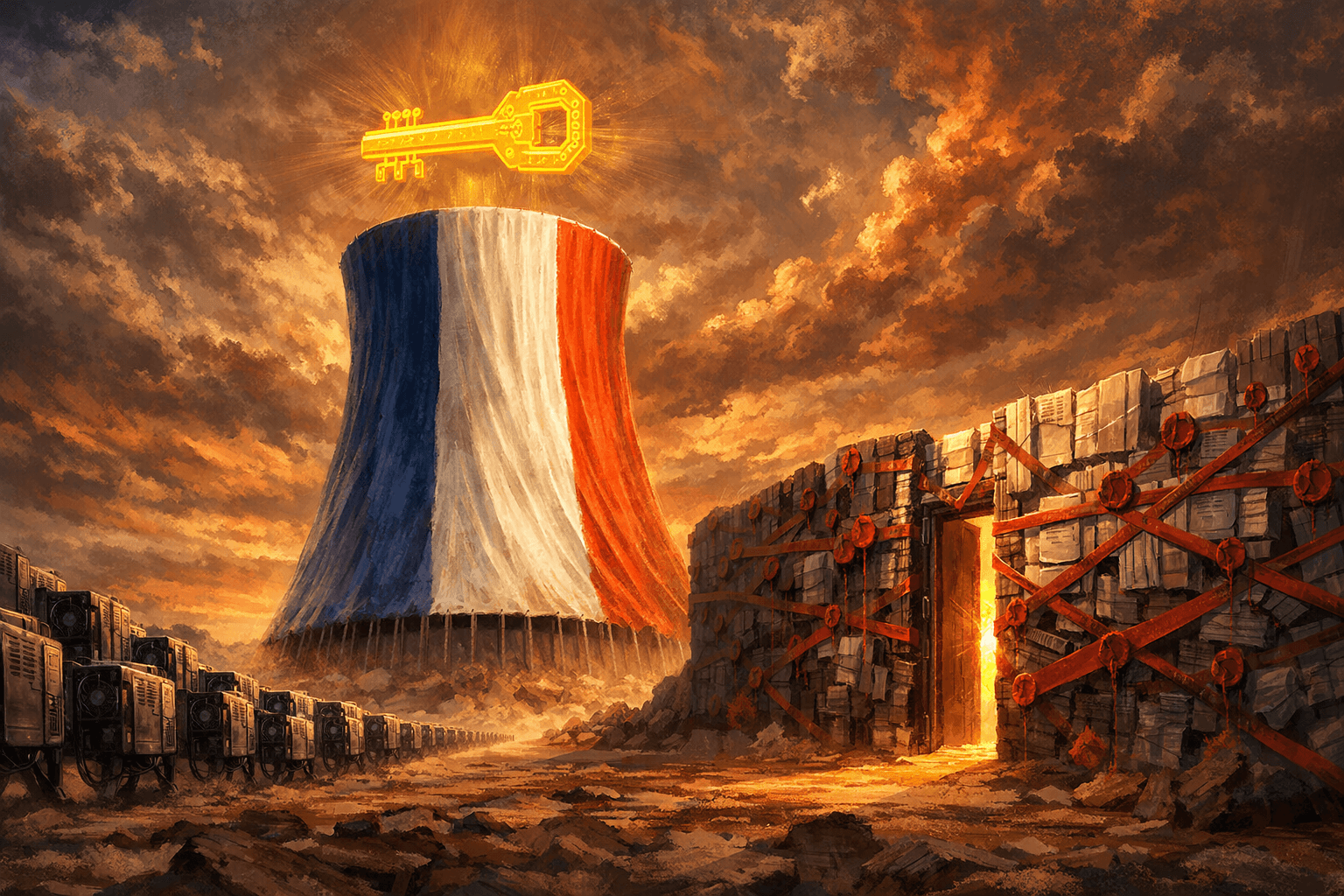
France has cleared the way for MARA Holdings, the Florida-based bitcoin miner traded on NASDAQ under ticker MARA, to acquire a 64% controlling stake in Exaion, a high-performance computing subsidiary of state-owned energy giant Electricite de France (EDF). The deal, valued at $168 million and first announced in August 2025, closed on February 20, 2026, after months of regulatory scrutiny rooted in national security concerns over foreign control of critical digital infrastructure.
The approval did not come easily. French Finance Minister Roland Lescure framed it as a balance between "France's attractiveness for international investment" and "uncompromising protection of our strategic interests and our technological sovereignty." In practice, that meant Paris attached a set of strict conditions that reshape the deal's governance, data handling, and ownership structure.
The Sovereignty Conditions France Demanded
The French government imposed four key guardrails before signing off on the transaction.
First, MARA was required to bring in a local co-investor. NJJ Capital, the investment vehicle of French telecom billionaire Xavier Niel, must hold a 10% stake in MARA France, the local acquisition entity. This ensures a prominent French business figure has a seat at the table and a financial interest in how Exaion operates.
Second, EDF retains a minority stake and continues as an anchor client of Exaion. The state energy company does not walk away from its own subsidiary. It remains commercially tied to the infrastructure it built.
Third, all sensitive EDF data must be removed from Exaion before the handover completes. No proprietary energy grid data, nuclear operations intelligence, or classified state information stays behind for a foreign acquirer to access.
Fourth, Exaion's board expands to eight members with balanced representation: three from MARA, three from EDF Pulse Ventures, one from NJJ, and Exaion's own CEO and co-founder. No single party holds an outright majority of board seats, even though MARA owns 64% of the equity.
These are not cosmetic conditions. They represent one of the most structured sovereignty frameworks ever applied to a bitcoin mining company's acquisition.
Why MARA Wants a French Energy Cloud
The strategic logic is straightforward: Exaion sits on top of EDF's energy grid, which runs primarily on nuclear power. France generates roughly 70% of its electricity from nuclear plants, giving it some of the cheapest and lowest-carbon power in Europe. For a bitcoin miner whose largest operating cost is electricity, securing access to nuclear-priced energy in a politically stable European jurisdiction is a generational asset.
But this is not purely a mining play. Exaion operates high-performance computing data centers specializing in enterprise cloud, edge computing, and AI inference workloads. MARA CEO Fred Thiel, who will join Exaion's board alongside Niel, has signaled that the company intends to position Exaion as a leading European player in AI infrastructure, not just crypto mining. The convergence of bitcoin mining, AI compute, and sovereign energy is the thesis.
At $168 million for a 64% stake, the implied enterprise value of roughly $262 million for a nuclear-powered HPC operator looks modest compared to the multibillion-dollar valuations that U.S. data center companies command. If AI demand continues to grow and European data sovereignty regulations tighten, Exaion could become far more valuable than its current price tag suggests.
What This Means for Europe's Crypto Infrastructure
This deal establishes a template. If a U.S. bitcoin miner can acquire a majority stake in a French state-owned computing subsidiary, with the right conditions, it signals that European governments are not categorically opposed to crypto-adjacent companies owning critical infrastructure. They just want control mechanisms.
For the broader European crypto ecosystem, the implications run deeper. MARA now has a physical footprint in France, a jurisdiction governed by MiCA and part of the European Economic Area. That infrastructure could serve as a launchpad for compliant crypto services across Europe. Card issuers, self-custody wallet providers, and DeFi protocols that need European-hosted compute could find a willing partner in MARA's expanded Exaion.
The NJJ Capital angle also matters. Xavier Niel is one of France's most connected technology investors, with deep ties across European telecoms and digital infrastructure. His involvement adds a political buffer that pure foreign ownership would not provide. It is a model other crypto companies eyeing European expansion should study closely.
The Bigger Picture: Nation-States and Hash Power
MARA's Exaion acquisition fits a pattern that has been accelerating since 2024. Nation-states and their energy companies are no longer treating bitcoin miners as nuisances. They are treating them as strategic partners who can monetize excess energy capacity, anchor demand for renewable and nuclear generation, and bring foreign capital into domestic infrastructure.
The UAE's Royal Group miners have accumulated over 6,700 BTC. El Salvador made bitcoin legal tender. Kazakhstan licensed mining operations through its AIFC framework. Now France, historically one of Europe's most protectionist economies, has found a way to let a U.S. miner into its energy ecosystem while preserving sovereignty.
The deal also arrives at a moment when bitcoin mining profitability faces pressure. Mining difficulty recently surged 15% in the biggest single adjustment since 2021, squeezing margins for operators paying market-rate electricity. MARA's move to lock in nuclear-priced power in Europe is a direct hedge against the rising difficulty environment. Cheap energy is the only durable moat in mining.
Overview
France approved MARA Holdings' $168 million acquisition of a 64% stake in Exaion, EDF's high-performance computing subsidiary, after imposing strict sovereignty conditions including a mandatory French co-investor (NJJ Capital, 10% stake), removal of all sensitive EDF data, retained state minority ownership, and balanced board representation. The deal gives the U.S. bitcoin miner direct access to France's nuclear-powered energy grid, one of the cheapest in Europe, while establishing a precedent for how crypto companies can acquire European state-linked infrastructure without triggering a sovereignty backlash. MARA plans to use Exaion for both bitcoin mining and AI compute workloads.