Core Scientific, the largest publicly traded Bitcoin miner by power capacity, sold 1,900 BTC for approximately $175 million in January 2026 at an average price of roughly $92,100 per coin. As of March 2026, with Bitcoin trading near $67,000, the company timed the exit well. What it did with the proceeds tells a bigger story: every dollar is going toward AI data center infrastructure, not back into mining.
The company's Q4 2025 earnings, reported on March 2, confirmed what the balance sheet already implied. Core Scientific is no longer a Bitcoin miner that dabbles in AI hosting. It is an AI infrastructure company that still happens to mine some Bitcoin on the side, and even that is winding down.
1,900 BTC Gone in 30 Days, and Mining Called a "Runoff"
Core Scientific ended 2025 with 2,537 BTC on its balance sheet. By the end of January, that number was approximately 630. The company sold 75% of its Bitcoin stack in a single month.
CFO Jim Nygaard told analysts the company would "remain opportunistic" with future sales, but the language around mining operations was blunter. Management described the self-mining segment as "essentially in runoff," a term typically reserved for insurance books and legacy loan portfolios that companies no longer plan to grow.
The numbers back it up. Q4 2025 self-mining revenue fell to $42.2 million from $79.9 million a year earlier, a 47% decline. The company mined 57% fewer Bitcoin quarter over quarter, even as BTC's average price rose 20% during the period. Core Scientific is not just producing less Bitcoin. It is actively shrinking the operation.
Q4 Revenue Missed by 31%, and the Stock Cratered
The headline financials were rough. Total Q4 revenue came in at $79.8 million against a consensus estimate of $122.08 million, a 31% miss. The company reported a loss of $0.42 per share versus the $0.08 loss analysts expected. CORZ shares sank in after-hours trading following the release.
The adjusted EBITDA number was worse: negative $42.7 million, down from positive $13.3 million in Q4 2024. Operating costs for the AI buildout are front-loaded, and revenue from the CoreWeave contract has not yet ramped.
One bright spot: net income hit $216 million, but that figure was inflated by warrant fair value gains, not operating performance. Strip out the accounting tailwinds and the quarter was a miss across almost every line item.
Management also disclosed an accounting restatement affecting property, plant, and equipment values from 2024 and interim 2025 periods. The company had improperly capitalized demolished assets, overstating PP&E. Core Scientific said the restatement does not affect revenue, EBITDA, or cash flows, but it adds another layer of noise to an already messy earnings print.
The CoreWeave Deal Is the Entire Bet
The strategic thesis now rests on a single counterparty: CoreWeave, the GPU cloud provider backed by Nvidia. Core Scientific signed a 590-megawatt hosting contract with CoreWeave and has broken ground on five AI data center campuses to fulfill it:
- Two brownfield expansions in Denton, Texas and Marble, North Carolina
- Three greenfield builds in Muskogee, Oklahoma, and two phases in Dalton, Georgia
The company has energized approximately 350 megawatts so far and expects to deliver the full 590 MW by early 2027. CoreWeave is funding $226.2 million of the $279.2 million in Q4 capital expenditures, covering the bulk of the buildout cost.
The potential scale is enormous. Core Scientific cited over $10 billion in contracted revenue from its AI pipeline and a target of 1.5 gigawatts of leasable power capacity by 2028. At that point, management said every single megawatt in the portfolio will be dedicated to AI colocation. Zero megawatts for mining.
One important context: Core Scientific shareholders rejected a full acquisition by CoreWeave in Q4. The deal would have created a vertically integrated neocloud provider. Shareholders said no, preferring independence. That means Core Scientific needs the CoreWeave hosting contract to work as planned, without the safety net of being acquired by its biggest customer.
What BTC Holders and Miners Should Watch
Core Scientific is not the first miner to pivot. MARA posted a $1.7 billion Q4 loss on a Bitcoin markdown and announced its own AI data center partnership with Starwood. The pattern is becoming industry-wide: miners who spent years accumulating BTC and hashrate are now selling both to chase AI infrastructure margins.
The implications for Bitcoin's supply dynamics are real. When large miners shift from accumulating to liquidating, the market loses a consistent bid. Core Scientific's 1,900 BTC January sale added roughly $175 million in sell pressure at prices 35% above where Bitcoin trades today. If other miners follow the same playbook, the sell-side overhang grows.
For mining difficulty, the effect is subtler. Core Scientific is not unplugging machines overnight. It is letting mining contracts expire and reallocating power as leases turn over. But 57% less production quarter over quarter is a steep decline, and every megawatt that flips from mining to AI hosting is a megawatt that no longer secures the Bitcoin network.
The longest mining capitulation on record recently ended with a Hash Ribbon recovery signal, but Core Scientific's exit suggests the capitulation was not just about price. It was about economics. AI hosting margins, with contracted revenue and cost-plus pricing, look more predictable than the halving cycle's boom-and-bust swings.
The Broader Shift: Mining Infrastructure Becomes AI Infrastructure
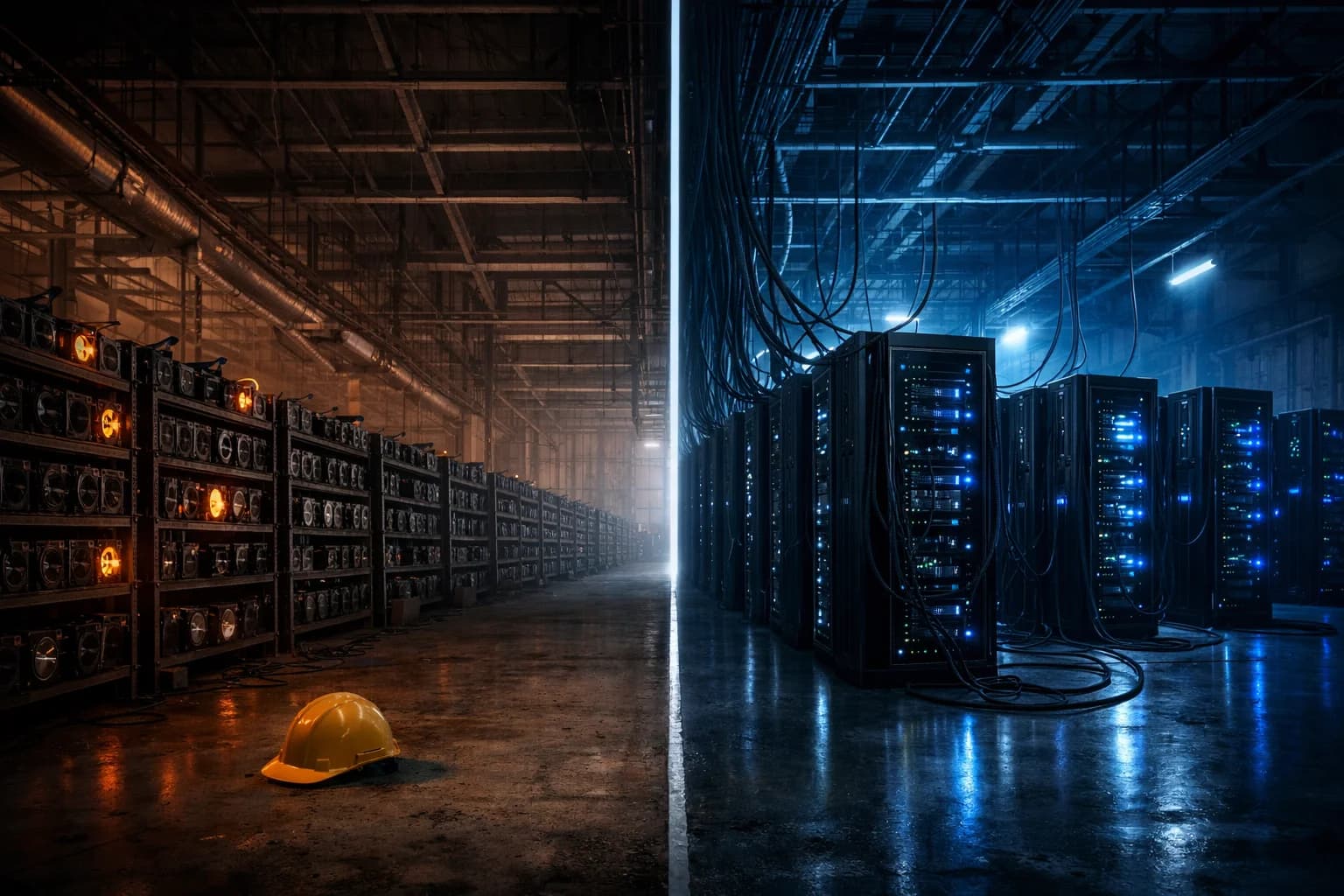
Core Scientific's transformation reflects a structural change in how crypto mining infrastructure gets valued. In 2021, the pitch was simple: cheap power plus ASICs equals Bitcoin. In 2026, the pitch is: cheap power plus GPU racks equals AI compute.
The assets are largely the same. Land, grid interconnections, cooling systems, and power purchase agreements transfer cleanly from one workload to another. What changes is the customer base. Instead of earning block rewards denominated in a volatile asset, these companies earn contracted hosting fees denominated in dollars. Wall Street prefers the latter.
Core Scientific ended 2025 with $530 million in liquidity and up to $4 billion in potential financing tied to its CoreWeave contract at stabilization. That financing capacity would have been unthinkable for a pure Bitcoin miner. It exists because the revenue is contracted, not speculative.
For the crypto card and wallet ecosystem, the ripple effects are indirect but meaningful. Miners have historically been one of Bitcoin's largest holder cohorts. As they convert BTC to fiat to fund AI capex, the float of actively traded Bitcoin increases. That means more liquidity for spending, but also more sell pressure during periods when retail demand is soft.
FAQ
How much Bitcoin does Core Scientific still hold? Approximately 630 BTC as of late January 2026, down from 2,537 at the end of December 2025. The company sold 1,900 coins for roughly $175 million at an average price of $92,100.
Why did Core Scientific miss Q4 revenue estimates so badly? Both the mining and HPC hosting divisions underperformed. Mining revenue fell 47% year over year as the company produced 57% fewer Bitcoin, while AI colocation revenue, though growing (up to $31.3 million from $8.5 million), has not yet reached the scale needed to offset the mining decline.
What is the CoreWeave contract worth? The 590-megawatt hosting deal is part of a pipeline that Core Scientific values at over $10 billion in contracted revenue. CoreWeave is funding the majority of the capital expenditure for the buildout.
Is Core Scientific still mining Bitcoin? Technically yes, but management described mining as "essentially in runoff." The company plans to reallocate all power capacity to AI colocation by the end of 2028.
Did shareholders approve the CoreWeave acquisition? No. Core Scientific shareholders rejected the acquisition proposal in Q4 2025, choosing to remain independent while fulfilling the hosting contract.
Overview
Core Scientific sold 75% of its Bitcoin holdings in January 2026 for $175 million, reported a Q4 revenue miss of 31%, and told investors its mining operations are in runoff. The company is betting its future on a 590-megawatt AI hosting contract with CoreWeave, backed by over $10 billion in pipeline revenue and a target of 1.5 gigawatts of AI-dedicated power by 2028. It is the clearest signal yet that the Bitcoin mining industry's infrastructure is being repurposed for artificial intelligence, with miners choosing contracted dollar revenue over volatile block rewards.
Recommended Reading
- MARA Posts a $1.7 Billion Q4 Loss on a Bitcoin Markdown, Then Jumps 17 Percent After Announcing an AI Data Center Pivot With Starwood
- One of the Longest Bitcoin Mining Capitulations on Record Is Ending, and the Hash Ribbon Just Flashed Its First Recovery Signal
- SpaceX Bitcoin Stack Shrinks From $780 Million to $545 Million as a $1.75 Trillion IPO Filing Looms This Month